
Local SEO in 2026: How NZ Small Businesses Can Win the Map Pack (and Still Get Found in AI Overviews)
If you run a plumbing business in Tauranga, a cafe in Wellington, or an accounting firm in Christchurch, the way people find you has quietly split into two different games this year. There's the old game: showing up in Google's Local Pack (the map and three listings that appear for "near me" searches). And there's the new game: getting mentioned in Google's AI Overviews, the AI-generated summary that now appears above the traditional results for roughly half of all searches.
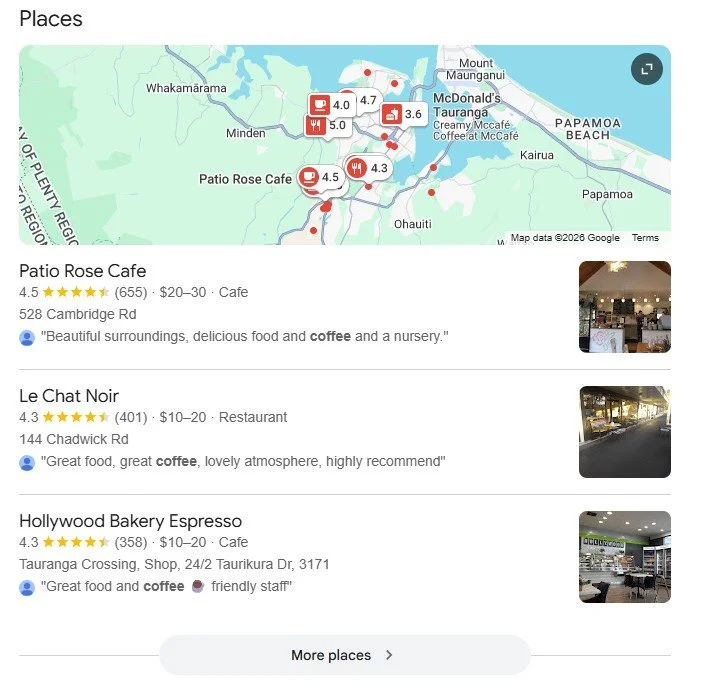
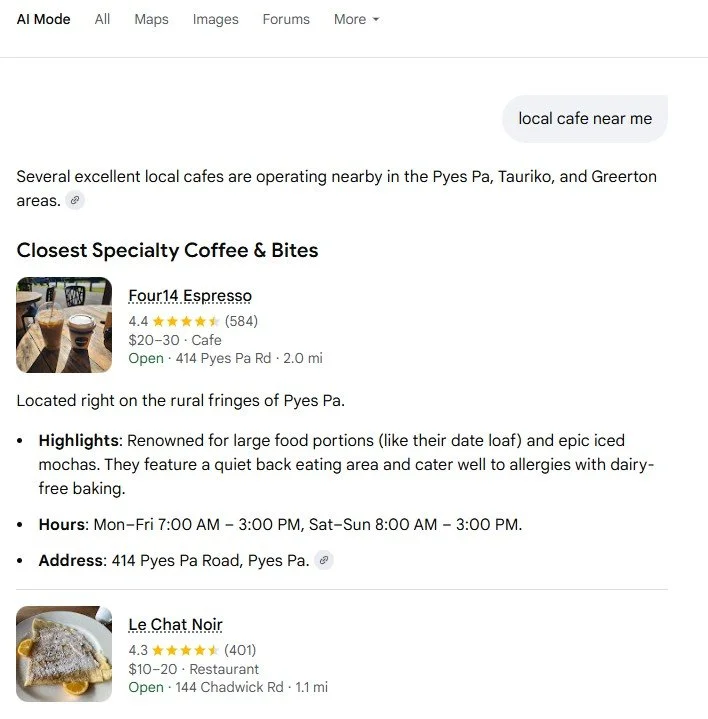
Here's the uncomfortable bit. Ranking well in the old game no longer guarantees you show up in the new one. Recent data shows citation overlap between top-10 organic rankings and AI Overview mentions has dropped from around 76% in mid-2025 to somewhere between 17% and 54% in early 2026. In plain English: being page one doesn't automatically get you quoted by the AI anymore. That's actually good news for small NZ businesses, because it means a clear, trustworthy, well-organised business can leapfrog bigger competitors who are coasting on old rankings.
Let's break down what's actually working right now, and what NZ business owners should be doing about it.
Your Google Business Profile is still the foundation
Before you touch anything else, get your Google Business Profile (GBP) sorted. It remains one of the most consistent local ranking factors, and a fully completed profile gets roughly 7 times more clicks than an incomplete one, plus around 70% more requests for directions or in-store visits. Yet close to 41% of small local businesses are still running with incomplete profiles: missing hours, no photos, vague categories, or descriptions that haven't been touched in years.
The fix is genuinely simple and takes an afternoon:
Pick the most specific category available (not just "Store", but "Electrician" or "Physiotherapist")
Add real photos of your team, premises, and work, updated seasonally
Fill in the products/services section in full
Post updates at least monthly (specials, new stock, project photos)
Keep hours accurate, especially around NZ public holidays
Reviews are doing more work than you think
Google reviews aren't just a trust signal for customers browsing your listing, they're a direct ranking input. Review signals (volume, star rating, recency, and even the keywords customers use inside their reviews) are estimated to make up around 17% of what decides who appears in the Local Pack. Businesses with 50+ reviews are roughly 266% more likely to appear in the Local Pack than those with fewer than 10.
Volume beats perfection here. A business with 50 reviews averaging 4.7 stars will typically outrank one with 5 reviews at a perfect 5.0, because volume signals that you're an established, ongoing concern rather than a business that asked five mates to leave a review once.
Practical steps for NZ businesses:
Ask for a review at the natural end of every job or transaction; don't wait for a follow-up email nobody opens
Make it a one-tap link (a QR code on the invoice or a text message works well)
Respond to every review within 24 hours, good or bad. Businesses that do this see average ratings around 0.12 points higher than those that don't reply at all
Never fake reviews. Google's detection has improved significantly and the penalty (delisting) isn't worth the short-term boost
NAP consistency and citations still matter
NAP stands for Name, Address, Phone number, and it needs to be identical everywhere your business appears online: your website, GBP, Facebook, Yellow, Finda, industry directories, and anywhere else you're listed. Inconsistent details (different phone numbers, "St" versus "Street", an old address after a shift) quietly erode trust signals that Google uses to confirm your business is legitimate.
Run a quick audit: search your business name in Google and check every listing that comes up. Fix anything that doesn't match exactly.
Write for AI Overviews, not just rankings
This is the part most NZ small businesses are missing entirely. AI Overviews now appear for somewhere between 47% and 64% of all search queries, and organic click-through rates on those queries have taken a real hit (informational query CTR has dropped by 34-58% when an AI Overview appears above the fold). If your content isn't structured to be quotable, you're invisible in a growing share of searches, even if you rank well.
To get cited by AI Overviews, structure your web content like you're answering a direct question, because you are:
Open each key page or blog section with a direct, plain-English answer to the question in the heading, before you elaborate
Use clear H2/H3 headings phrased as questions ("How much does a bathroom renovation cost in Auckland?")
Include specific numbers, prices, timeframes and NZ-specific detail. Vague copy doesn't get quoted, specifics do
Add a short FAQ section near the bottom of service pages
Keep each section useful as a standalone chunk. AI systems often pull one paragraph, not the whole page
Local keywords still need a home
Structure content around patterns like "service + location" (Auckland roof repairs), "problem + location" (leaking roof Auckland) and "service + qualifier + location" (emergency roof repairs South Auckland). Use these naturally in page titles, headings, body copy, and image alt text, not stuffed in but genuinely woven through content that answers what a local customer actually wants to know.
The bottom line for NZ business owners
Local SEO in 2026 isn't one thing anymore; it's two: get your GBP, reviews, and citations right to win the map pack, and structure your content to be clearly quotable to win a slot in AI Overviews. The businesses that do both are the ones showing up twice on the same search results page, once in the map pack and once in the AI summary above it. The businesses doing neither are becoming invisible, even with a nice-looking website.
If you want a proper audit of where your business currently stands, both in traditional local search and in AI Overviews, that's exactly the kind of thing we do at DigiKraft. Get in touch and we'll show you precisely what's holding your local visibility back, and what to fix first.
